How to write an effective apprenticeship cover letter?(with samples)
Summary
- What is a cover letter and why is it important?
- 5 tips for writing a persuasive cover letter
- Bonus: Template of a cover letter for an apprenticeship
- Key takeaways
An apprenticeship is the beginning of your professional life and it's exciting! There is just one little problem: you do not how to write the cover letter to apply for apprenticeship.
Don’t worry, we have the situation under control. To put all the chances on your side, follow all our tips and tricks to write the letter that will make the difference.
1. What is a cover letter and why is it important?
The cover letter is the first impression you give to the hiring manager. This first contact is all the more important when your experience is limited and your CV a bit short. In the case of a speculative application, the cover letter is even more essential. Indeed, you are anticipating the recruitment process, and you need to convince the hiring manager that you are the ideal candidate.
The cover letter is still the must-have to persuade the hiring manager that you are better than the other candidates. Hence, writing a cover letter to apply for apprenticeship is a crucial step.
2. 5 tips for writing a persuasive cover letter
1. Structure the content
The cover letter follows some rules. Your cover letter should be 3-4 paragraphs:
- One paragraph about the candidate: show that you are suitable for the position. Mention your diplomas, your level of qualification, your experiences, etc. Show your motivation. To do so, insist on the reasons why the company should hire you. If you are undergraduate, highlight your experience, even if you acquired it during odd jobs. If you have a master’s degree, specify what kind of position you are looking for.
- One paragraph about the company. The aim here is to show that you are interested in the company and that you chose this company among its competitors because its values suit you.
- One paragraph about the training projects and missions you could perform for the company.
- One sentence that reaffirms how diligent and serious you are. Let them know that you will contact them within a week.
- Complimentary close.
2. Be relevant
The hiring manager has only a limited amount of time and a lot of applications. Help him/her find the information he/she wants as quickly and as simply as possible. To do so, you have two options: attach the schedule of your apprenticeship to the mail, or mention in the cover letter your starting date at the company and your school/university schedule. These elements are essential for the organisation of the company.
3. Be in the right state of mind
Applying for an apprenticeship means asking a company to contribute to your training. Be natural, but always polite and modest: keep in mind that the company that accepts you will make you progress, and, in the end, contribute to your professional integration.
4. Be careful of your writing
Write your apprenticeship cover letter with dedication. The cover letter is a personalised piece that goes along your CV, but it should not be a summary of your CV. The cover letter should highlight your assets in a simple and clear manner. If anything, the cover letter elaborates on the information on your CV in order to spark interest about you. Reading the cover letter should allow the hiring manager to take on your application, and/or to meet you.
5. Proofread your letter, open your grammar book
You know what they say - the devil is in the details. So you had better have your cover letter proofread to avoid spelling mistakes, typos or repetitions. Be it for an apprenticeship or for any other position, spelling and syntax are real criteria for hiring managers. Your application may be the same as the other candidates, the chosen one will be the one who makes no mistakes!
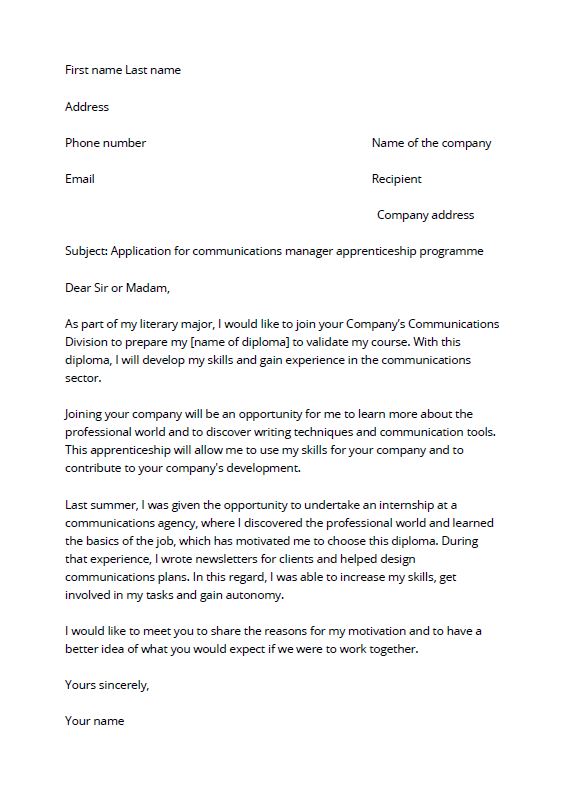
3. Bonus: template of a cover letter for an apprenticeship
To help you, here is a template of a cover letter for an apprenticeship. Feel free to use this as a guideline for your apprenticeship or internship applications. Keep in mind that your cover letter should not exceed one page!
4. Key takeaways
The time has come to muster your writing skills. Let's write the cover letter that will get you the apprenticeship of your dreams! Remember, be concise, be relevant. You did your research on the company, you are able to personalise your application and you know how to respect the rules of a cover letter.
Why is a cover letter so important for an apprenticeship?
A cover letter is the first impression you make on the hiring manager, which is even more important when you have limited professional experience and a relatively short CV. It is essential for convincing employers, in a competitive market, that you are the best candidate for the position.
How should you structure a cover letter for an apprenticeship?
A cover letter generally consists of three to four paragraphs: one about yourself (your qualifications, experience, and motivation), one about the company (your interest in the organisation and alignment with its values), and one about your training plans and the responsibilities you could take on. It should then end with a sentence reaffirming your motivation and a polite closing.
Should you mention your apprenticeship schedule in the cover letter?
Yes. It is advisable to be practical by mentioning your start date with the company and the work-study schedule set by your school or university. Alternatively, you can attach the schedule to your application. These details are important for the company’s planning and organisation.
Should the cover letter repeat the content of your CV?
No. A cover letter should not be a summary of your CV. Instead, it should complement the information already included in your CV and generate interest in your profile. It should present your strengths in a clear and coherent way that encourages the hiring manager to meet you.
How long should an apprenticeship cover letter be?
Your cover letter should not exceed one page. It is also essential to proofread it carefully to eliminate spelling mistakes, typos, and repetition, as these details can make the difference between two otherwise similar applications.
In summary
A cover letter is often the first point of contact with a hiring manager, making it particularly important when your CV is still limited or when applying speculatively. To be effective, it should be structured into three or four clear sections covering your profile, the company, your training project, and a professional closing. It should remain practical by clearly stating your apprenticeship schedule and key dates, while maintaining a natural, polite, and humble tone. Your cover letter should be personalised and carefully written without simply repeating your CV, adding context and value to the information already presented. Finally, it should be thoroughly proofread to avoid any spelling or grammar mistakes. A cover letter template can provide a useful starting point, but remember to keep your final version concise and limited to one page.